
Friends and Lovers

In this issue of Gohar Nameh, we explore the quiet strength of friendship, the kind that endures through distance, disagreement, and time. In today’s world of fleeting connections, it is worth remembering how deeply friendships have shaped Iranian life and literature, offering comfort, honesty, and companionship when they are needed most.
We’ll also touch on recent Silenced Whispers updates and upcoming events.
These days, most of us boast of hundreds, if not thousands, of friends on social media who “like” every step of our baby’s life and every snapshot of our vacation, and we forget how precious a true friendship is. But it was not too long ago that friends were the ones—and sometimes the only ones—who stayed by one’s side through thick and thin, providing mental and physical support.
Friendships are vital in a segregated society like Iran, where families could drift apart, and marriages were arranged between parties that had never met each other and were far apart in age and education. It’s no surprise that in Farsi, the two words: Yar and Doost, mean both friend and lover. The pillar of Iranian literature, Rumi, even dedicated a collection of his absolute best poetry to his friend, Shams Tabrizi.


My grandmother’s best friend was a woman I had always assumed to be a family member, but later on found out was a friend. She was present at weddings and funerals, doing what was needed, from caring for the sick to supervising children in my grandmother’s absence. We knew her as Khanjoon, which is an abbreviated form of “Khanum Joon,” meaning dear lady, not a real name. Only recently did my uncle tell me her name was Sakinheh, and that she had a family of her own.
My grandmother had three sisters and five brothers. But being the eldest of nine when she lost her father at seventeen and her mother only three years later—her youngest sibling was only two when their father passed —she always acted as a parent for others. With an absent husband, she needed someone she could let herself be vulnerable with and be her friend, advisor, helper, and nurse. Khanjoon was all that and more.
Our society tends to celebrate romantic love more than friendship. But our close friends are the ones we can truly bare our souls to; the ones whom we hide nothing from. They “get” us, as Rumi says, they are “more me than me,”


Friends are not always serious and careful. They bring us joy and play. And sometimes, they take part in our daring adventures. Khanjoon once accompanied my grandmother on a harrowing trip in the middle of World War II in occupied Iran, in an old bus, to travel from Tehran to join my grandfather in Isfahan, with six kids, the eldest 14, the youngest newly born, and without a man. Talking about gutsy.
They don’t always agree with us, either. Good friends challenge us but also bring us hope when we are deep in sorrow. In a poem, Hafez’s friend challenges him in everything, even in the praise of the freshening morning wind, where his friend states that the breeze from the lover’s house is superior. But later in the same poem, when Hafez laments the end of festivities, his friend reminds him that everything will pass, including hard times.


Disagreements are especially difficult to navigate in a polarized society like ours. Sometimes we even have to caution our friends about those who are too complimentary—including AI “friends”. Rumi warns of such flatterers: “Tricksters salute you, pledge their lives to serve you,” but it is the true friend who “tells the truth, in harsh tones.”
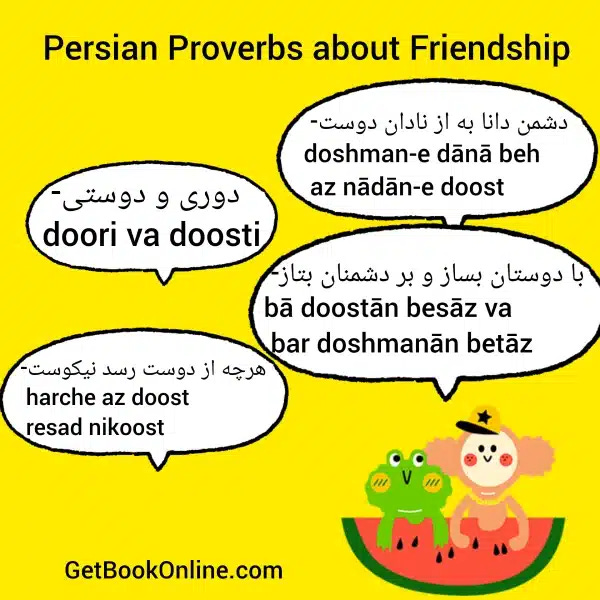
Farsi has many proverbs dealing with conflict between friends. They all emphasize the importance of getting along with friends through good and bad times, such as “Cope with friends, fight with the enemies” and “Whatever comes from friends is benign.” Arguments are part of human discourse. If we want total agreement, we can find a chatbot to be our friend. Unfortunately, more young people than ever select that route—the Reddit forum for those whose only friend is a chatbot has thousands of subscribers.
Friends are not infallible, either. But they make up for it with loyalty. In the story of Siavash in Shahnameh, the advice of Piran, delivers Siavash to his enemy, Afarsiab. But Piran makes up for it by saving the life of Siavash’s son, Key Khosrou, and helping him take his rightful place as the king of Iran.
While good friendships withstand distance, they don’t fare well with neglect. A postcard, or even a private text, does a lot when we are away.
Let’s conclude this newsletter with a poem from Rumi’s Divan-e-Shams, talking about the joy his friend brings.
“The gloomy who doesn’t rejoice at seeing you,
May he be disgraced, doomed, and lost.”
Silenced Whispers Updates
We had a wonderful weekend at the Camden Conference in Kennebunk! The conversations were engaging, the Q&A sparked thoughtful questions, and the energy of organizers and audience made it an absolute joy to be there.
A huge thank you to the organizers for making it all possible, and especially to Allison Atkins for her kindness and support throughout.


The Happenings
Join Afarin tomorrow night, Thursday, October 23 @ 6:30 PM, for an Author Talk at Camden Public Library, 55 Main St, Camden, ME 04843
Saturday, December 13 @ 2 PM - Author Talk at Fowler Library, 1322 Main Street, Concord, MA, 01742
Register here: https://concordlibrary.assabetinteractive.com/calendar/fowler-author-talk-afarin-bellisario/
Thursday, Jan. 29 2026 @ 5:30 PM - Author talk at Portland Public Library, 5 Monument Sq, Portland, ME 04101
The series, “Library Talks,” offers something fresh each time about Iranian modernization, its relevance today, and how my novel, Silenced Whispers, portrays this pivotal era. This format encourages returning guests to discover new insights at every talk. The event will conclude with a Q&A session and book signing.
Until next time;
Afarin & The Gohar Nameh Team